Wednesday, 27 February 2013

Romanticism Artists


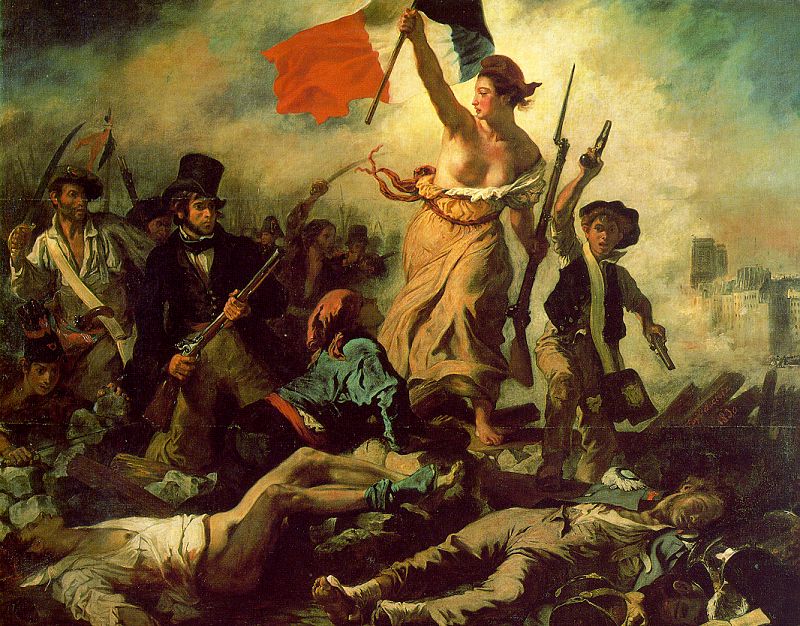
Eugene Delacroix - Liberty Leading the People, 28th July – 1830


Eugene Delacroix in his painting “Liberty Leading the People” wanted to tell the story of Three GloriousDays-the Parisian uprising on July 27, 28 and 29 of 1830, because he was touched by the three daysof revolt by the upper-class, the middle-class and the lower-class. In this artwork Liberty is depicted in the form of an energetic, disobedient woman who leads the people to victory while carrying the flag proudly.
Delacroix used the pyramid shape as composition; the figure of Liberty is the peak and focal point, while the dead fighters beneath her are the base. He repeated the colours of the French flag to show the power of France and the power of her people. He uses light to illuminate Liberty and also a death fighter beneath her. The tone he used invokes a sense of freedom, power and victory, while of course commemorating those who dead fighting for their cause and country.
This artwork was rejected by contemporary critics and was hidden from public view until the year Delacroix died, because critics at that time refused to accept Delacroix’s mix of reality with fiction, because for them it was too advanced and imaginative.
This painting entered the Musee du Luxembourg in 1863, the same year Delacroix died and then 11 years later it was moved to the Louvre.  


Bibliography
Artble. 2013. July 28: Liberty Leading the People. [online] Available at: <http://www.artble.com/artists/eugene_delacroix/paintings/july_28:_liberty_leading_the_peoplel> [Accessed 21 February 2013].
 
 
Francisco Goya - The Executions of May Third, 1808 – 1814
 
The Third of May 1808 in Madrid: the executions on Principe Pio hill


Francisco Goya wanted to depict the execution of patriots from Madrid by a firing troop from Napoleon’s army, who were punished for their revolt against the French position on the second of May, 1808. He painted the French soldiers on the right of the composition with their rifles aiming the Madrilenian who were going to die. Goya in his painting used light to show drama and tension in the scene and he also illuminate it the heroes, making it possible to distinguish their characters and attitudes in that particular situation.
This painting entered the Prado Museum as part of the Royal Collection in Madrid.
 
Bibliography
Museo Nacional del Prado. 2013. Museo Nacional del Prado. [online] Available at: < http://www.museodelprado.es/en/the-collection/online-gallery/on-line-gallery/obra/the-3rd-of-may-1808-in-madrid-the-executions-on-principe-pio-hill/ > [Accessed 21 February 2013].


No comments:

Post a Comment